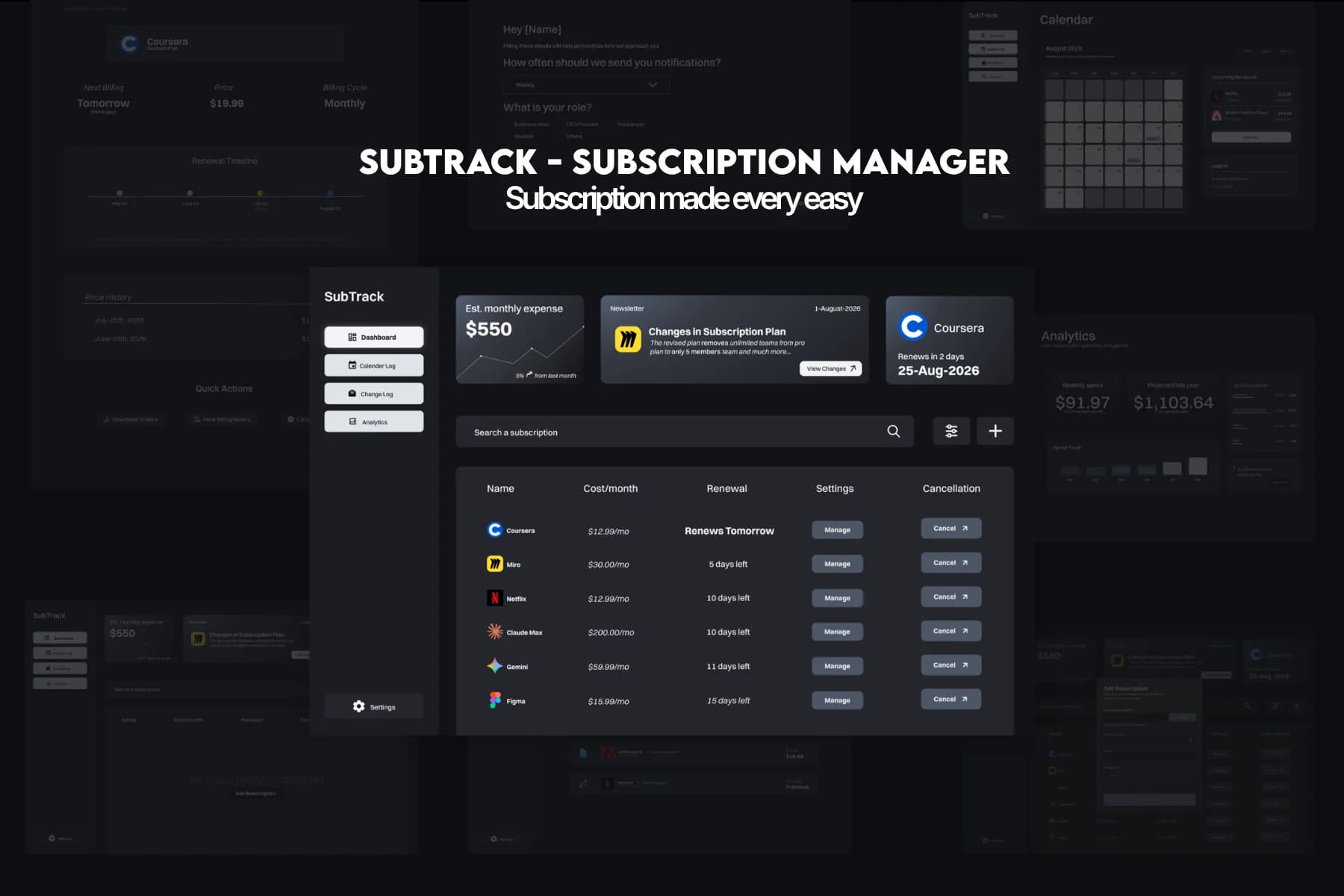
A subscription-tracking app built around a cancellation flow that refuses to promise what it can’t verify.
- The Problem
76% of 642 apps use dark patterns
A joint FTC / ICPEN / GPEN study (2024) found that 76% of 642 subscription apps use at least one dark pattern to block cancellation. "Cancel anytime" is a promise users have learned not to trust.
- The Move
Three steps each way, symmetric
Built a subscription manager that refuses to claim what it can't prove. Three steps to add. Three steps to start leaving. The signup and cancellation paths are literally the same length.
- The Mechanism
Redirect, not process
Every cancellation redirects to the subscription's own site rather than being processed in-app. A post-redirect check-in confirms the handoff; the product never claims a completion it can't verify.
- The Outcome
$1,796 ARR / 5.4x value
$1,796 modeled annual recurring revenue per 1,000 free users at a $4.99 price and 3% conversion, delivering 5.4x the per-user cost of a competitive premium tier. Modeled, not measured.
Every action hands the user to the subscription’s own site instead of processing it in-app. The product can only confirm it asked, not that a cancellation went through.
Comparing a full signup to a full cancellation stopped being fair once the app stopped owning either end. What survived: three steps to add a subscription, three to cancel one.
Price and plan changes are detected automatically and logged with no confirmation step. A false positive can reach the user stated as fact, a trade-off named rather than hidden.
- FigmaEvery editable screen and component; hand-assembled
- ClaudeDesign-system spec, verification script, layout discussion
- Google StitchCalendar-screen ideation (rebuilt by hand)
- MobbinPattern reference for dashboards and detail views
- DribbbleVisual reference for calendar and analytics treatments
Need a product problem solved?